The Complete Guide to Nutrition for Fitness
Trained hard for weeks but barely seeing results? The problem usually isn't your workout — it's your fuel. Here's the complete science of how nutrition turns training into progress.
The Question Behind the Struggle
Have you ever trained consistently for weeks — showing up, putting in the work — and barely noticed a change? Strength that will not climb, a physique that will not shift, energy that runs out halfway through the session?
If the training is happening, why aren't the results?
Most people answer that question by adding more — more sessions, more intensity, more time in the gym. But nutrition is often one of the missing pieces. Training sends the demand; nutrition supplies what the body needs to answer it. When the two are out of sync, even a good program quietly underperforms.
This guide is the complete picture — calories, protein, carbohydrates, fats, hydration, micronutrients, timing, supplements, recovery, and sleep — built on current sports-nutrition science. Not rules to obey. A system to understand, so your eating and your training finally point in the same direction. It starts with a simple shift in how you see the whole process.
Your Body Is a Construction Project
The simplest way to understand the relationship between training and nutrition is to picture a building going up.
- Training is the blueprint and the demand. It tells the body what to build and why the current structure is no longer enough.
- Nutrition is the raw material. Protein, energy, and micronutrients are the bricks, the steel, and the concrete. Without them, the order sits unfilled.
- Sleep is the construction crew's working hours. The actual building happens during rest — not while you lift.
Miss any one and the project stalls. You can hand the crew a brilliant blueprint, but with no materials, nothing rises. This is why people who train hard on poor nutrition feel stuck: the signal is loud, but the body has nothing to build with. To see why that is, it helps to look at what a workout is really doing.

What Training Actually Does
Here is the part that reframes everything: your training sets the entire process in motion — and nutrition is what lets your body finish what the workout started.
A hard set is the trigger. It stresses the muscle fibers, draws down fuel stores, and starts a wave of controlled inflammation. This is exactly what you want — it is the demand that tells your body to come back stronger. But the actual rebuilding happens afterward, in the hours and days that follow, and that is the part nutrition powers.
In that recovery window, the body ramps up muscle protein synthesis — building new proteins to repair and reinforce what the session challenged. Endurance training triggers its own parallel adaptations in the systems that produce and use energy. Every one of these responses is real progress, and every one of them is paid for in nutrients and rest.
This is why training and nutrition are partners, not competitors. A great workout creates the opportunity; the right nutrition is what turns that opportunity into a stronger, fitter body. (For the full mechanism of how that repair becomes growth, see our guide to how muscle actually grows.) With that partnership in mind, let's build the nutrition side from the ground up — starting with the foundation everything else rests on.
Start With Energy: Calories Set the Direction
Before protein, before carbs, before a single supplement — energy comes first. Calories are simply a measure of energy, and your body spends that energy on far more than workouts: breathing, circulation, brain function, digestion, temperature, tissue repair, daily movement, and sleep all run on it.
Your total daily energy expenditure is shaped by your resting metabolism, everyday movement and step count, the type and intensity of your training, the energy used to digest food, your body size and composition, and factors like age, genetics, sleep, and stress. Add it all up and you get the number that sets your direction:
- A sustained calorie deficit generally drives weight and fat loss.
- Eating near maintenance supports weight stability, performance, and body recomposition.
- A controlled calorie surplus, paired with resistance training, supports muscle gain.
But more is not automatically better. A bigger deficit often does drop weight faster — but it also raises the risk of losing muscle, draining your training, and making the plan too hard to stick to. And a bigger surplus does not mean more muscle; it mostly means more fat. The best calorie target is the one that moves you toward your goal while still letting you train, recover, sleep, and live well.
Chronically under-fueling an active body — too little energy left after the cost of exercise — can quietly damage recovery, hormones, bone health, immunity, and mood in both women and men. Persistent fatigue, stalled performance, frequent illness, disrupted menstrual function, or a sudden drop in motivation deserve attention, not more restriction. These have many causes, so don't self-diagnose; a physician and dietitian can assess them properly.
Calories set the direction, but they don't tell the whole story. The same calorie total can build muscle or lose it, fuel a great session or leave you flat — depending on how it's split across the three macronutrients. Protein comes first.
Protein: Repair, Remodeling, and Muscle Retention
If calories set the direction, protein is the material your body builds with. It supplies the amino acids used to repair and remodel muscle tissue after training, helps preserve lean mass while dieting, and keeps you fuller between meals.
For most active adults, a practical, evidence-based range is 1.4 to 2.0 grams of protein per kilogram of body weight per day2. Someone dieting aggressively or doing high volumes of resistance training benefits from the upper end; needs shift with training type, age, body composition, and goal. The daily total matters most — but spreading it across three to five meals, rather than crowding it into one, makes the plan both more effective and more practical.
Strong protein sources include:
- Eggs, poultry, lean meat, and fish
- Greek yogurt, cottage cheese, milk, and other dairy
- Tofu, tempeh, edamame, and other soy foods
- Lentils, beans, chickpeas, and peas
- Whey, casein, soy, pea, or blended protein powder when convenient
Well-planned plant-based diets can absolutely support strength and muscle goals — the key is enough total protein, a variety of sources, and portions that cover your essential amino acids.
And no, you don't need to sprint to a shake the second your last set ends. The old "30-minute anabolic window" is far wider than the myth suggests. Eat a protein-containing meal within a few hours before or after training, keep hitting your daily total, and the timing takes care of itself. With the raw material covered, the next macro is what powers the training itself.
Carbohydrates: Training Fuel and Glycogen Restoration
Carbohydrates are your body's preferred fuel for hard work. They break down into glucose and are stored as glycogen in muscle and liver — the fuel tank your body draws on during moderate-to-high-intensity training, repeated hard efforts, and long sessions.
Carb needs are not one-size-fits-all; they should rise and fall with your training. A casual lifter training three times a week does not need the same fueling as a marathon runner or a two-a-day athlete. Quality sources include rice, oats, potatoes, pasta, whole-grain breads, fruit, beans, lentils, dairy, and vegetables. Around training, easier-to-digest choices often feel better; at other meals, higher-fiber carbs support fullness and overall diet quality. (We cover exactly how to place carbs before, during, and after a session in the timing section below.)
That leaves the third macro — the one people cut too aggressively and pay for in hormones and hunger.
Dietary Fat: Hormones, Cells, and Vitamins
Fat is not just stored energy. It supplies essential fatty acids, builds the membranes of every cell, helps you absorb the fat-soluble vitamins A, D, E, and K, and makes meals genuinely satisfying. Cutting it too low is a common mistake that quietly affects hormones and enjoyment alike.
Favor mostly nutrient-dense sources: olive oil, avocado, nuts and seeds, nut and seed butters, fatty fish like salmon and sardines, plus the fat that comes with eggs and dairy. Because fat digests slowly, it is great for fullness but can sit heavily before a hard session — keep it in your overall diet and adjust pre-workout portions to your own tolerance. And since fat is calorie-dense, portions still matter when fat loss is the goal.
Protein, carbs, and fat supply the energy and building blocks. But a much smaller class of nutrients quietly runs the machinery that puts them to work.
Micronutrients: Small Nutrients, System-Wide Roles
Vitamins and minerals provide no calories, but they run the machinery behind everything else — energy metabolism, oxygen transport, bone remodeling, muscle contraction, and immune function all depend on them. Active people should pay particular attention to a few:
- Iron — especially for people who menstruate, endurance athletes, and those eating little or no meat.
- Calcium and vitamin D — for bone and muscle function.
- Vitamin B12 — a key consideration on vegan diets.
- Magnesium — involved in hundreds of metabolic processes.
- Sodium and electrolytes — when sweat losses are high.
A varied, minimally processed diet built from multiple food groups usually covers your micronutrient base. Supplements are not automatically required, and mega-dosing "just in case" can be useless or even harmful. Suspected deficiencies should be checked with proper clinical guidance and, where relevant, lab testing.
Now you have the parts. The next question is how to assemble them into meals you'll actually eat — without turning food into a math problem.
Build the Plate: Food Quality Without Chasing Perfection
Calories and macros are the numbers, but two diets with identical numbers can differ enormously in fiber, micronutrients, fullness, and enjoyment. Quality is what fills that gap — and it does not require a rigid, joyless diet.
A simple, repeatable foundation is to build most meals from five parts:
- A protein source
- Vegetables and/or fruit
- A carbohydrate source matched to your activity
- A source of healthy fat
- Water or another appropriate fluid
Whole and minimally processed foods make it easier to hit fiber and micronutrients, but more processed foods can still fit a purpose — a sports gel on a long run, cereal before an early session, or a protein shake on a busy day all earn their place. The best fitness diet is not the one with the most rules. It is the one that covers your needs and stays realistic enough to actually follow, week after week. Once that plate is consistent, you can start fine-tuning when you eat.
Nutrient Timing: The Fine-Tuning Layer
Timing is real, but it is the last layer, not the first. It only pays off once the daily foundations — total calories, enough protein, decent food quality, and hydration — are already consistent. Get those right first; obsessing over timing while the basics are shaky is polishing a car with no engine.
Once the foundation is solid, a little structure around your sessions can help:
- Before training: a meal with carbohydrate for energy and some protein, kept moderate in fat and fiber if you're eating close to the session. A larger meal works two to four hours out; a smaller snack suits a tighter window.
- During training: water covers most sessions under an hour. Add carbs and electrolytes for long, intense, or hot-weather work.
- After training: a balanced meal with protein to rebuild, carbohydrate to refill glycogen, and fluid to rehydrate. There is no single "perfect" post-workout food — the best one fits your schedule, digestion, and daily targets.
You can also match your carbohydrates to the day's demands — placing more of them around your hardest sessions. This kind of tuning is genuinely useful for athletes juggling high training volume, but it is an optimization on top of a solid daily plan, not a starting point. Nail your daily calories, protein, and consistent meals first; adjust the finer timing only once those are automatic.

Food is only half of intake. The other half — often overlooked until performance drops — is fluid.
Hydration and Electrolytes
Even mild dehydration makes training feel harder, especially in heat or during long sessions. But hydration is not a contest to drink as much water as possible — overdoing it can dangerously dilute your blood sodium. The goal is balance, not volume.
Fluid needs vary widely with body size, sweat rate, climate, clothing, and session length, so a few practical habits beat any fixed number:
- Start your training already well hydrated.
- Drink to thirst and to the conditions, not on a rigid schedule.
- Notice unusually heavy or salty sweat losses — and replace both fluid and sodium after them.
- For repeatable sessions, weighing yourself before and after can estimate sweat loss when you want more precision.
Urine color is a rough guide, not a perfect test — supplements, foods, and first-morning concentration can all skew it. Fuel and fluid in place, everything now converges on the phase where results are actually made.
How Nutrition Powers Recovery
Recovery is not one protein shake or one rest day. It is the accumulated result of adequate energy, protein, carbohydrate, fluid, micronutrients, and sleep — the conditions that let your body actually complete what training started.
Good recovery nutrition helps the body repair muscle tissue, restore glycogen, rehydrate, and return ready for the next session. When recovery is consistently poor — energy dragging, performance sliding, sleep broken — the fix is rarely "train harder." It is to examine the whole picture: total calories, protein, hydration, sleep, life stress, and whether the training load itself is realistic. Recovery is where the results are made — it's what turns a hard session into a stronger body.

Those are the universal foundations. But the exact way you apply them shifts with what you're chasing — muscle, fat loss, or performance. Here's how the same system bends to each goal.
Nutrition for Muscle Growth
Building muscle is not about one magic nutrient. It is a coordinated set of conditions, and nutrition supplies most of them:
- Progressive resistance training — the signal to grow.
- Adequate total energy — building tissue costs calories.
- Sufficient daily protein — the raw material for repair and remodeling.
- Carbohydrate — to fuel the hard training that drives the stimulus.
- Sleep and recovery — when the building actually happens.
- Time and consistency — the ingredient no shortcut replaces.
A controlled calorie surplus can make muscle gain more efficient, but bigger is not better — large surpluses add body fat faster without producing proportionally more muscle. And there's good news for anyone earlier in the journey: beginners, people returning after a break, and those carrying higher body fat can often build muscle and lose fat at the same time. This "body recomposition" is slower on the scale, which is why strength trends, measurements, and photos matter more than a single morning's weigh-in.
Notice that half of that list is nutrition and recovery, not lifting. (For the full mechanism, see how muscle actually grows.) Losing fat runs on the same system — pointed in the opposite direction.
Nutrition for Fat Loss — Without Wrecking Your Training
Fat loss comes down to a sustained energy deficit — but how you create that deficit decides whether you keep your muscle, your strength, and your sanity. A crash approach burns the very things that make you fit; a smart one protects them.
A durable fat-loss plan emphasizes:
- A moderate, manageable deficit — not the steepest cut you can tolerate.
- High protein — to preserve muscle and control hunger while calories are low.
- Resistance training — the signal that tells your body to keep the muscle it has.
- Fiber-rich, high-volume foods — more food, more fullness, fewer calories.
- Enough carbohydrate to power your key sessions.
- Sleep and stress management — both quietly shape hunger and adherence.
Expect the scale to bounce around with water, glycogen, sodium, digestion, and hormonal cycles. Judge progress over several weeks, not a single reading — and when it stalls, first check consistency and the honesty of your tracking before reaching for a drastic cut or an extra hour of cardio. More restriction is rarely the answer that lasts. Beyond muscle and fat, the same nutrition quietly governs how you feel and perform every single day.
Nutrition for Performance, Energy, and Sleep
Many people think cardio alone decides fat loss and lifting alone decides muscle — but nutrition quietly sets the ceiling on both, and on nearly everything you feel day to day: focus, energy, endurance, strength, recovery speed, and even sleep quality all move with what you eat.
The links run in both directions. Underfuel, and workouts feel flat and concentration fades. Overdo caffeine or alcohol late, and sleep suffers — which then worsens hunger, cravings, and training the next day. A few habits protect the whole system:
- Eat enough across the day; going to bed extremely hungry can disrupt sleep.
- Avoid very large, heavy meals right before bed if they cause discomfort.
- Set a caffeine cutoff that fits your sensitivity — it can linger for many hours.
- Keep alcohol modest; it may bring drowsiness but degrades sleep quality later in the night.
- If dinner is early, a small protein-rich evening snack can help meet your daily target.
Foods and supplements studied for sleep — tart cherry, kiwi, tryptophan-rich proteins, melatonin — show some promise, but none replace the fundamentals: a consistent schedule, a dark, cool room, sensible light exposure, and managed caffeine and stress. Persistent insomnia, loud snoring, or major daytime sleepiness deserves medical assessment.
Understand all of that, and you're already ahead of the noise — the fad diets and miracle supplements that promise to skip the fundamentals.
Do Fad Diets Actually Work?
Keto, intermittent fasting, carnivore, detoxes, juice cleanses — every year brings a new one promising a shortcut. The honest, evidence-based answer is simple: a diet "works" only to the extent that it creates the right energy balance and enough protein while you can actually stick to it. The label on top matters far less than whether the fundamentals underneath are intact.
Some approaches can fit certain people and preferences — lower-carb eating suits some, and time-restricted eating is just one way to manage total calories. Others, like detoxes and juice cleanses, promise things the body already does on its own and often strip out protein and fiber in the process. None of them override energy balance, and none are magic.
We'll break each of these down in detail in a dedicated article. For now, the takeaway holds: if a diet quietly delivers appropriate calories, enough protein, and foods you can sustain, it can work; if it doesn't, no name on the box will save it.
Supplements: What Helps, What's Optional, What Needs Caution
Supplements should solve a specific problem, not serve as the starting point. Before buying one, ask what outcome you're targeting, whether your food already covers it, whether the evidence is strong, whether it's safe with your health and medications, and whether it's been third-party tested. With that filter, a short list actually earns its place:
- Protein powder — a convenient food, not a requirement. Useful when appetite, schedule, or preferences make your protein target hard to hit.
- Creatine monohydrate — one of the most studied supplements, supporting strength, power, and repeated high-intensity work. A common maintenance dose is 3 to 5 grams daily. The small weight bump it causes is water in muscle, not fat.
- Caffeine — can improve alertness and performance, but response varies and more is not better. High or late doses cost you sleep — which erases the benefit.
- Electrolytes and sports drinks — useful during prolonged exercise, heavy sweating, or heat; not needed for every workout.
- Omega-3s, vitamin D, iron, magnesium — worth considering in context, ideally guided by diet, sun exposure, or lab testing rather than guesswork.
Be cautious with pre-workouts, "fat burners," and proprietary blends, which can hide stimulant doses and contaminants. Competitive athletes should stick to third-party-certified products. And no supplement replaces the foundation: consistent training, sufficient food, hydration, and sleep. Which raises the real question — how do you keep all of that consistent?
Do You Actually Need to Track Calories and Macros?
Not everyone does. Someone focused on general health can do very well with regular meals, a balanced plate, adequate protein, and honest attention to hunger and fullness. Tracking every calorie is not a moral requirement.
But the moment your goal gets specific — losing a defined amount of fat, gaining muscle on a controlled surplus, hitting a real protein target, fueling a heavy training block — guessing stops working. And this is where most people quietly stall, because the gap is rarely effort. It's information.
Consider how easily the numbers hide from you. You eat "healthy" all week and still fall short on protein without realizing it. You choose nutritious, calorie-dense foods and unknowingly erase the deficit you thought you were in. You train hard but under-eat the carbohydrate that session actually needed. Every one of these is invisible in the moment — and every one is the difference between progress and a plateau.
The problem isn't that the information doesn't exist. It's that it's scattered across every meal, disconnected from what you're training for. To make it useful, your calories, protein, carbs, and fats have to be visible in one place — tied to the exact goal you're working toward. That's the entire idea behind Endopamin Nutrition: your workout tells your body what to build, and your nutrition supplies the materials, so the app keeps both in the same plan instead of leaving you to guess. You see how your daily choices add up, learn your repeatable patterns, and make small, informed adjustments with real context.

Done right, tracking creates clarity, not anxiety. Estimates are never perfect — labels, portions, and wearables all carry error — so consistency beats false precision. And if tracking ever fuels restriction or old disordered patterns, that's the signal to step back and get support from a qualified professional. The tool exists to serve the goal, never the other way around.
Your Practical Nutrition Framework
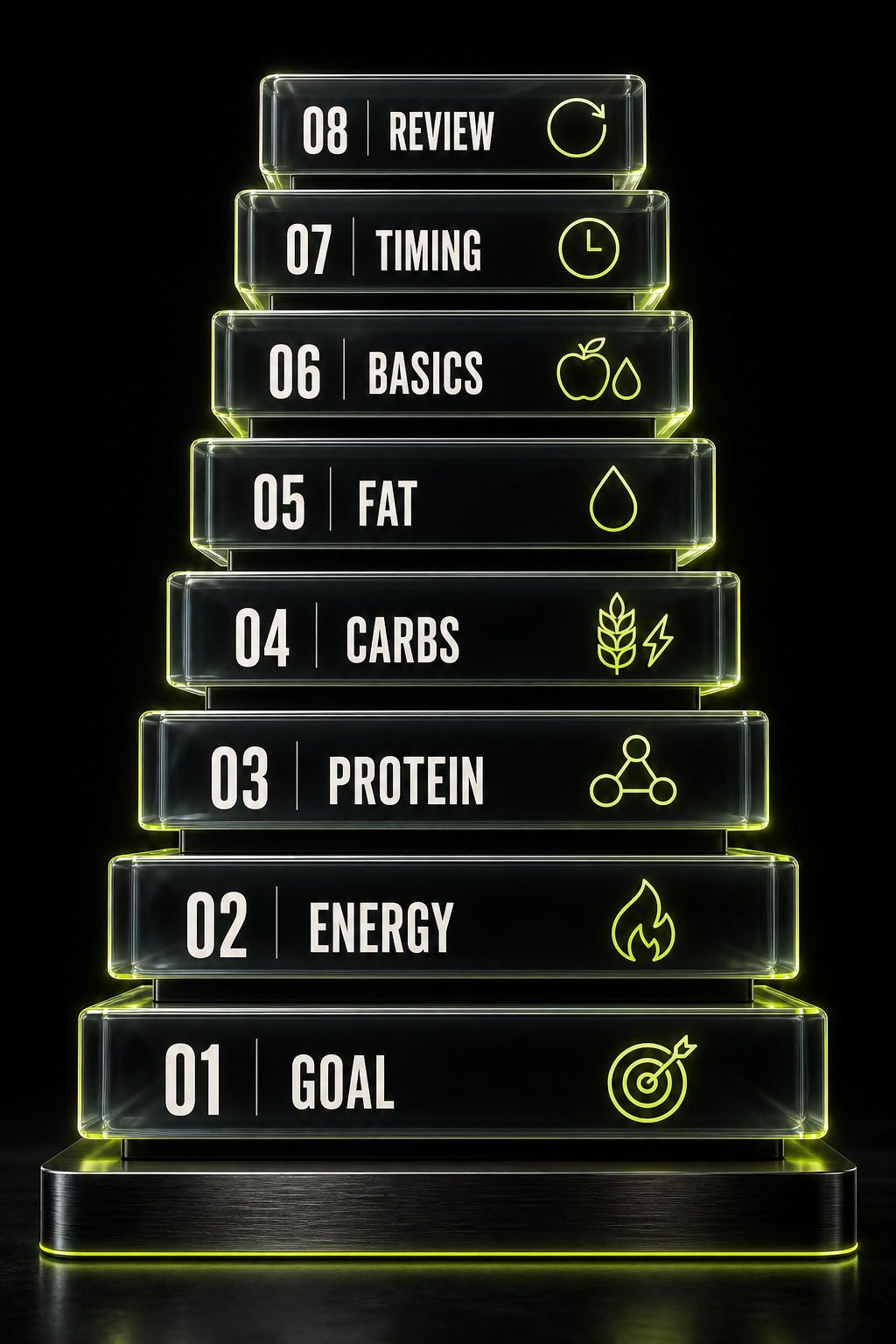
You do not need to redesign your whole diet in a day. Build it in order, one layer at a time:
- Define the goal — performance, muscle, fat loss, maintenance, or general health.
- Estimate an energy target — a starting point, not a verdict; adjust to real-world trends.
- Set protein — a realistic daily total, spread across meals you already eat.
- Match carbohydrates to training — more around your hardest sessions.
- Include enough fat — mostly nutrient-dense, portioned to your calorie target.
- Cover the basics — fruit, vegetables, fiber, fluid, and variety.
- Add timing and supplements only where useful — the polish, not the base.
- Review trends, not single days — adjust one or two variables at a time.
Example Day of Eating for an Active Adult
This is a structure, not a prescription — portions should match your own energy and macro needs. The point is the roles each meal fills, which stay the same across cuisines, budgets, and preferences.
- Breakfast: Oats made with milk or fortified soy milk, Greek or soy yogurt, berries, and nuts.
- Lunch: A rice bowl with chicken, tofu, or beans; mixed vegetables; salsa; and avocado.
- Pre-workout snack: Banana and a protein yogurt, or toast with a protein shake.
- Post-workout dinner: Salmon, lean meat, tempeh, or lentils with potatoes or pasta and vegetables.
- Optional evening snack: Cottage cheese, Greek or soy yogurt, or fruit with a small serving of nuts.
Common Fitness Nutrition Mistakes
- Copying someone else's calorie target. Two people with the same goal can have very different energy needs and responses.
- Chasing protein while ignoring total energy. Protein matters, but the body still needs enough fuel and a complete diet.
- Cutting carbs without considering training. Lower-carb can suit some goals, but it's a poor match for repeated high-intensity work.
- Treating supplements as the starting point. They're easier to market than daily habits, and their real benefit is narrow.
- Changing the plan after every weigh-in. Daily weight is noisy; decide from trends and multiple signals.
- Trying to eat perfectly. Perfection makes fragile plans. Consistency and flexibility make durable ones.
The Bottom Line
Training challenges the body. Nutrition supplies the energy and building blocks that let it recover, adapt, and show up ready for the next challenge. Everything in this guide comes back to a few simple priorities, applied consistently — enough total energy, enough protein, carbohydrate matched to training, healthy fats and whole foods, sensible hydration, and protected sleep.
You do not need a flawless diet to make progress. You need a plan that matches your training, supports your health, and can be repeated long enough to work.
Endopamin keeps your calories, protein, carbs, and fats connected to the goal you're training for — workouts and nutrition in one plan, so nothing gets left on the table.
Build Your Nutrition Plan →Frequently Asked Questions
What is the best diet for fitness?
There is no single best diet for everyone. A strong fitness diet provides appropriate calories, enough protein, carbohydrates matched to training, sufficient healthy fats, micronutrient-rich foods, fiber, and fluid — and it fits your preferences, culture, budget, and schedule so you can actually sustain it.
How much protein do I need to build muscle?
Many active adults can use roughly 1.4 to 2.0 grams per kilogram of body weight per day as an evidence-based planning range, with the higher end useful when dieting or training at high volume. Your ideal target depends on training, energy intake, age, body composition, and health status.
Should I eat before or after a workout?
Both can help. A pre-workout meal supports the session and a post-workout meal supports recovery, but your daily totals for calories, protein, and carbohydrate matter far more than hitting a perfect minute-by-minute schedule.
Do I need supplements to get fit?
No. Supplements are optional tools. Protein powder adds convenience, and creatine and caffeine have solid evidence in specific situations, but food, training, hydration, and sleep remain the foundation.
Is calorie counting necessary for fat loss?
Fat loss requires an energy deficit, but logging every calorie isn't mandatory. Some people succeed through portions and habits. Tracking helps most when your target is precise, progress has stalled, or you want to see how your current intake compares with your goal.
Can nutrition improve recovery and sleep?
Yes. Adequate energy, protein, carbohydrate, fluid, and micronutrients support recovery, while meal size, timing, caffeine, and alcohol all influence sleep. Nutrition helps, but it works alongside good sleep habits and an appropriate training load.
Can I build muscle and lose fat at the same time?
Often yes — especially for beginners, people returning to training, and those with higher body fat. Resistance training, sufficient protein, a carefully set calorie intake, sleep, and patience are what make this "recomposition" possible.
References
- Thomas DT, Erdman KA, Burke LM. Position of the Academy of Nutrition and Dietetics, Dietitians of Canada, and the American College of Sports Medicine: Nutrition and Athletic Performance. Journal of the Academy of Nutrition and Dietetics. 2016;116(3):501–528. doi:10.1016/j.jand.2015.12.006
- Jäger R, Kerksick CM, Campbell BI, et al. International Society of Sports Nutrition position stand: protein and exercise. Journal of the International Society of Sports Nutrition. 2017;14:20. doi:10.1186/s12970-017-0177-8
- Morton RW, Murphy KT, McKellar SR, et al. A systematic review, meta-analysis and meta-regression of the effect of protein supplementation on resistance training-induced gains in muscle mass and strength in healthy adults. British Journal of Sports Medicine. 2018;52(6):376–384. doi:10.1136/bjsports-2017-097608
- Mountjoy M, Ackerman KE, Bailey DM, et al. 2023 International Olympic Committee's consensus statement on Relative Energy Deficiency in Sport (REDs). British Journal of Sports Medicine. 2023;57(17):1073–1097. doi:10.1136/bjsports-2023-106994
- Kerksick CM, Arent S, Schoenfeld BJ, et al. International Society of Sports Nutrition position stand: nutrient timing. Journal of the International Society of Sports Nutrition. 2017;14:33. doi:10.1186/s12970-017-0189-4
- Sawka MN, Burke LM, Eichner ER, Maughan RJ, Montain SJ, Stachenfeld NS. American College of Sports Medicine position stand: exercise and fluid replacement. Medicine & Science in Sports & Exercise. 2007;39(2):377–390. doi:10.1249/mss.0b013e31802ca597
- Kreider RB, Kalman DS, Antonio J, et al. International Society of Sports Nutrition position stand: safety and efficacy of creatine supplementation in exercise, sport, and medicine. Journal of the International Society of Sports Nutrition. 2017;14:18. doi:10.1186/s12970-017-0173-z
- Guest NS, VanDusseldorp TA, Nelson MT, et al. International Society of Sports Nutrition position stand: caffeine and exercise performance. Journal of the International Society of Sports Nutrition. 2021;18:1. doi:10.1186/s12970-020-00383-4
- Maughan RJ, Burke LM, Dvorak J, et al. IOC consensus statement: dietary supplements and the high-performance athlete. British Journal of Sports Medicine. 2018;52(7):439–455. doi:10.1136/bjsports-2018-099027
- Hevia-Larraín V, Gualano B, Longobardi I, et al. High-protein plant-based diet versus a protein-matched omnivorous diet to support resistance training adaptations. Sports Medicine. 2021;51(6):1317–1330. doi:10.1007/s40279-021-01434-9
- Barnard J, Roberts S, Lastella M, Aisbett B, Condo D. The impact of dietary factors on the sleep of athletically trained populations: a systematic review. Nutrients. 2022;14(16):3271. doi:10.3390/nu14163271
- Aragon AA, Schoenfeld BJ. Nutrient timing revisited: is there a post-exercise anabolic window? Journal of the International Society of Sports Nutrition. 2013;10:5. doi:10.1186/1550-2783-10-5
Medical & Nutrition Disclaimer
This article provides general educational information and is not medical or individualized nutrition advice.
People with medical conditions, a history of disordered eating, who are pregnant, or who use medication should consult an appropriately qualified healthcare professional before making major dietary changes or using supplements. Individual nutrition needs vary.
Editorial note: This article summarizes the sports-nutrition evidence available at the time of publication. Nutrition science continues to evolve, and the article will be reviewed periodically and updated when stronger human evidence or major consensus changes become available.